Mostrando entradas con la etiqueta Solar Power World. Mostrar todas las entradas

miércoles, 24 de agosto de 2016

Using stand-alone solar to secure large-scale solar sites

By Levy Acs, president of American Integrated Security Group (AISG)
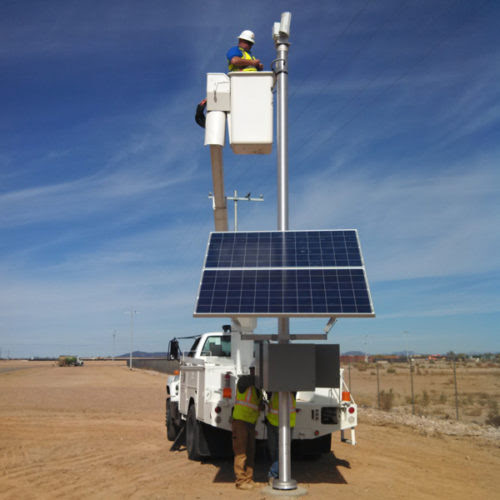
sample image for SPW articleStretching over an expansive range, large-scale solar generation sites can be challenging and expensive to secure if not done properly. Security at solar farms not only involves the ability to safeguard critical infrastructure from outside threats, but they also help deter copper theft, protect personnel and limit disruption of power for huge numbers of consumers. Security being a major concern, it is essential in the planning stage of solar site development to enlist the services of an experienced security systems integrator to handle the security side of the project. A five-year veteran of securing solar generations sites, American Integrated Security Group has worked with a large range of clients.

Much of AISG’s success comes from understanding the market and developing great relationships as a partner, serving the needs of solar contractors, project developers, EPCs, owner/operators and utilities. Employing the latest network electronic technology coupled with unique integrated packaged devices, AISG, based in College Point, New York, delivers the most cost effective systems available for 24/7 coverage. AISG solutions meet or exceed NERC security requirements.

Currently more than 30 U.S. solar facilities are protected with field-proven security from AISG, nearing 5 GW of secured solar projects. AISG uses the energy of solar itself to power the turnkey security system that incorporates perimeter security, video surveillance, access control and remote monitoring capabilities. Being under 24-hour surveillance ensures complete control of the entire site at all times. The case studies below offer insight into the type of services AISG provides.

Case Study 1

Client: Signal Energy

Site: Garland Solar Generating Facility in Mojave, California

Summary: A large-scale project requiring 22 self-contained solar-powered pole stations to cover 102,000 ft of fence, AISG installed video, access control, perimeter protection and remote monitoring at the site. Both communication and power are provided by AISG at the edge, eliminating trenching or the need for third parties to complete.

System Design: Located on approximately 2,000 acres in Kern County, California, the facility consists of more than 800,000 polycrystalline PV modules. Access is controlled at the site via an Aiphone IP video intercom and locked gates at multiple points of site ingress/egress. High resolution IP video surveillance utilizes Davantis video analytics and Wavestore video storage and management, integrated with environmental FLIR thermal and AXIS Communications day/night infrared IP cameras installed throughout the facility on solar powered poles with industrial network switches and wireless adapters for complete perimeter coverage. In addition, AISG is using strobe/sirens at each pole to pin-point and guide the authorities upon events.

Case Study 2

Client: Signal Energy

Site: Tranquility Solar Generating Facility in Fresno, California

Summary: Signal Energy enlisted AISG to install video, access control, perimeter protection and remote monitoring at the 3,800-acre site. The site consists of a large solar array, and two substations directly adjacent to a utility switching station. Outdoor storage for road maintenance materials, non-operational equipment and maintenance vehicles is located adjacent to the facility and within the project footprint.

System Design: The site is secured by approximately 95,000 ft of 8-ft-tall chain link perimeter fencing through which access is controlled via an Aiphone IP video intercom and locked gates at multiple points of site ingress/egress. High resolution IP video surveillance utilizes Davantis video analytics and a Wavestore video server integrated with environmental FLIR thermal and AXIS communication day/night infrared IP cameras installed throughout the facility on solar powered poles with industrial network switches and wireless adapters for complete perimeter coverage. In addition, AISG is using strobe/sirens at each pole to pin-point and guide the authorities upon events. AISG is also providing interactive remote video monitoring.

roserock-5.0Case Study 3

Client: McCarthy Building Companies

Site: Roserock Solar Facility in Pecos County, Texas

Summary: AISG is contracted by McCarthy Building Companies to provide long range detection and wide area surveillance. The Roserock facility requires 12 self-contained solar-powered pole stations to cover over 100,000 ft of fence. AISG installs a seamless and comprehensive security platform including video surveillance, access control, perimeter protection and remote monitoring to insure uninterrupted power production. Both communication and power are provided by AISG at the edge.

System Design: The solar facility is on 1,300 acres and consists of approximately 700,000 PV modules around which access is controlled at the site via an Aiphone IP video intercom and locked gates at multiple points of site ingress/egress. A high resolution IP video surveillance system for complete perimeter coverage uses Avigilon to integrate and manage Davantis video analytics and Wavesore VMS with environmental FLIR thermal and AXIS Communications day/night infrared IP cameras. The fully equipped solar powered poles utilize industrial network switches and wireless adapters. In addition, AISG is providing strobe/sirens at each pole to pinpoint and guide authorities upon events.

Case Study 4

Client: NRG Energy

Site: California Valley Solar Ranch in San Luis Obispo, California

Summary: NRG Energy contracted AISG to deploy a powerful solution at California Valley Solar Ranch including analytics, video storage and management, thermal surveillance cameras, access control and intercom, perimeter alarms and 24/7 surveillance monitoring from AISG’s College Point, New York, central station.

System Design: Encompassing a footprint of some 1,500 acres, 11 self-contained solar-powered pole stations and a Fiber Sensys fiber optics system is installed on the 19 miles of fence at the California Valley Solar Ranch. Access at the gates is controlled with Kantech access control and Aiphone IP intercom. The video portion of the platform uses Davantis video analytics technology, FLIR thermal cameras and a Wavestore server integrated and programmed to alarm at the AISG central monitoring station.

Completely Off the Grid and Self Sufficient

The contractors featured in these case studies choose AISG for its experienced security know-how. At every AISG-secured solar site, all AISG engineers and designers are well versed in the various federal and state regulations that accompany solar energy projects. Clients have stated that the AISG-provided analytics are great for speeding up searches of recorded video, the entire system ensures an integrated outdoor solution to enable better monitoring of vulnerable areas and they love the reliability of thermal imaging cameras. Video access to their sites drastically reduces operational costs and the need for round-the-clock security guards.

Altogether, AISG covers perimeters spanning thousands of acres and hundreds of thousands of linear feet with as little hardware and infrastructure as possible. Completely off the grid, the systems installed by AISG create a seamless and comprehensive security platform, guaranteeing uninterrupted power production. Designed for real-time threat detection and tracking while simultaneously providing a high degree of situational awareness, AISG provides improved performance over traditional perimeter security with extended long-range detection and wide-area day/night surveillance.


Solar Power World


from Solar Power World http://ift.tt/2biCata

U.S. installed price of solar fell by 12% in 2015

Solar energy system pricing is at an all-time low, according to the latest editions of two recurring “state of the market” reports released by the Department of Energy’s Lawrence Berkeley National Laboratory (Berkeley Lab).

Within the market for distributed solar photovoltaic (PV) systems, installed prices in 2015 declined by $0.20-per-watt (W) or 5% year-over-year for residential systems, by $0.30/W (7%) for smaller non-residential systems, and by $0.30/W (9%) for larger non-residential systems.  Prices for utility-scale PV systems that came online in 2015 fell by $0.30/W (12%) from the prior year.  Preliminary data for the first six months of 2016 suggest that prices have continued to fall within most states and market segments.

These and many other statistics can be found within two new Berkeley Lab reports. Tracking the Sun IX focuses on installed pricing trends in the distributed PV market, including both residential and non-residential sectors. Utility-Scale Solar 2015 focuses on the utility-scale market, describing installed prices, as well as trends related to the design, operating costs, capacity factors, and power purchase agreement (PPA) prices of utility-scale solar projects.

bl1“This marked the sixth consecutive year of significant price reductions for distributed PV systems in the U.S.,” notes Galen Barbose of Berkeley Lab’s Electricity Markets and Policy Group, the lead author of Tracking the Sun.  The continued decline is especially noteworthy given the relatively stable price of PV modules since 2012. The report attributes recent system price declines, instead, to reductions in other hardware costs and to solar “soft” costs. The latter includes such things as marketing and customer acquisition, system design, installation labor, and permitting and inspections.

Both reports also highlight the tremendous variability in PV system pricing. For example, among residential systems installed in 2015, 20 percent sold for less than $3.30/W, while another 20 percent sold for more than $5.00/W. As Berkeley Lab’s Naïm Darghouth explains, “This variability reflects a host of factors: differences in system design and component selection, market and regulatory conditions, and installer characteristics, to name a few.”

Utility-scale projects completed in 2015 also vary widely in price, with the cheapest 20 percent priced below $1.60/W, compared to the most expensive 20 percent priced above $2.60/W. Berkeley Lab’s Joachim Seel notes, “Some of the observed price differences between projects can be explained by varying lag times between contract negotiation and project completion, as some of these projects have been under development, or even construction, for several years.”

Project performance

Within the utility-scale sector, PV project performance—as measured in terms of “capacity factor”—has improved among more recently built projects, driven by advances in both technology and project design.  In particular, an increasing number of projects are deploying solar tracking technology to boost performance. In addition, developers have been augmenting the size of projects’ solar arrays relative to their inverters (resulting in higher inverter loading ratios, or ILRs), as another way to boost output.  Finally, over the past few years, projects have, on average, been built at sites with stronger solar resources, as measured by global horizontal irradiance (GHI).

bl2As shown in the figure to the right, changes in these three parameters have driven mean capacity factors higher by project vintage over the last four years, to nearly 27% among 2014-vintage projects (whose first full operating year was in 2015).

Power purchase agreement (PPA) pricing

Lower installed project costs and higher capacity factors have enabled levelized PPA prices from utility-scale PV projects to fall dramatically over time, by $20-$30/MWh per year on average from 2006 through 2013, with a smaller price decline of ~$10/MWh per year evident among PPAs signed in 2014 and 2015.  As shown in the figure below, most PPAs in the 2015 sample are priced at or below $50/MWh (levelized, in real 2015 dollars), with a few priced as aggressively as ~$30/MWh.  According to Berkeley Lab’s Mark Bolinger, “Falling PPA prices have enabled the utility-scale market to expand beyond the traditional strongholds of California and the Southwest into up-and-coming regions like Texas, the Southeast, and even the Midwest.”

Looking ahead, the improving economics of solar power demonstrated in these two reports, coupled with the extension of the 30% federal investment tax credit (ITC) through 2019, should drive a continued expansion in all sectors of the U.S. solar market over the next few years.

bl3Both reports, along with accompanying slide decks and data files, can be downloaded for free from trackingthesun.lbl.gov and utilityscalesolar.lbl.gov.

In addition, the extensive underlying database of project-level data developed for Tracking the Sun is available to the public and can be downloaded through the National Renewable Energy Laboratory’s Open PV Project.

Highlights of both reports will be presented through two separate webinars:

  • Tracking the Sun IX
    Wed, Sep 7, 2016, 10:00 AM Pacific Daylight Time
    Registration Link: http://ift.tt/2biBuUn
  • Utility-Scale Solar 2015
    Thu, Sep 8, 2016, 10:00 AM Pacific Daylight Time
    Registration Link: http://ift.tt/2biAGz2

The research was supported by funding from the U.S. Department of Energy SunShot Initiative. The SunShot Initiative is a collaborative national effort that aggressively drives innovation to make solar energy fully cost-competitive with traditional energy sources before the end of the decade. Through SunShot, DOE supports efforts by private companies, universities, and national laboratories to drive down the cost of solar electricity to $0.06 per kilowatt-hour. Learn more at energy.gov/sunshot.

News item from Lawrence Berkeley National Laboratory

Solar Power World


from Solar Power World http://ift.tt/2bgJLf2

Developers integrate Mounting Systems’ Sigma I Steel ground mount into this 1 MW project

mounting-systems-michiganAfter installers drove the last pile and mounted the last panel, Consumers Energy can finally celebrate the completion of a 1 MW solar project on the grounds of Western Michigan University’s (WMU) College of Engineering and Applied Sciences campus in Kalamazoo, MI. This photovoltaic development is part of Consumers Energy’s community Solar Garden program to harvest clean solar energy, which has also been recently implemented at Grand Valley State University in Allendale, MI. These Solar Gardens provide an opportunity for students to learn about the benefits of solar and our environmental impact on the community.

Consumers Energy worked with WMU to construct this project, which spans across nearly 10 acres. They also collaborated with Mounting Systems’ project managers to support the PV array with patented Sigma I Steel ground mounts. These ground mounts utilize a new, proprietary cold-rolled steel with Clickstone technology for speed and ease of installation. With ISO-9001 and UL 2703 certification, contractors could depend on the efficiency and reliability of ground mount installations through Mounting System’s services.

WMU is the second largest high-profile project to capitalize on Sigma I Steel ground mounts, following Grand Valley State University who used the ground mounts for their 3 MW solar array. Mounting Systems and Consumers Energy are excited to contribute to Michigan’s large-scale utility developments, especially over a relatively short amount of time.

“The Sigma I Steel mounting system utilizes advanced technologies in steel coating as well as the most innovative techniques in racking pre-assembly,” said Holger Giebel, CEO of Mounting Systems, Inc. “This results in a highly durable, long-lasting product that is both easy to install and extremely cost effective.”

With over 8 GW projects internationally and 22 years of experience, Mounting Systems is proud to contribute to another successful and economical improvement towards solar development.

News item from Mounting Systems

Solar Power World


from Solar Power World http://ift.tt/2bAfPIl

IKEA to install Washington’s largest rooftop solar array at relocated Seattle-area store

martes, 23 de agosto de 2016

Conergy announces financial close in Australian utility solar and storage project

Conergy, one of the world’s largest downstream solar companies, will commence construction this month on the first and largest utility-scale solar PV + battery storage project in Asia Pacific.

The AU$42.5 million Lakeland Solar and Storage (LSS) project located near Lakeland in North Queensland, Australia will consist of a 13MW solar array (featuring 41,440 solar panels) and a 1.4MW/5.3MWh Conergy “CHESS” storage solution. This full-scale commercial power plant has been designed to research and analyze various plant operating modes and demonstrate grid to islanding functionality, the ability to consistently feed renewable energy into the grid and demonstrate the capability of utility scale solar + storage, paving the way for the future of solar baseload and the future of power quality and supply.

Construction activities are scheduled to begin later this month with commissioning planned for the end of April 2017. Once the plant is operational, it is expected to produce over 22,600 MWh/year, the equivalent electricity to power up over 3,000 homes during the day and night, while avoiding over 21,150 tons of CO2 emissions. The solar plant will be connected to Ergon Energy’s existing substation – one of the most remote National Electricity Market (NEM) linked substations in Australia.

The project was initially acquired from a local developer in 2015 and subsequently developed, designed, engineered and brought to financial close by Conergy’s APAC development team. Conergy’s EPC team will be leading the plant’s construction activities while the Asset Management team will assume responsibility for all technical and commercial post-commissioning activities.

The achievement of this milestone for the LSS follows the exceptional coordination and cooperation of a multitude of partners and advisers. The Australian Renewable Energy Agency (ARENA) extended an AU$17.4 million grant to the project. German bank NORD/LB has provided a 15-year non-recourse financing facility for the project, with Norton Rose Fulbright providing legal Counsel to Conergy. BHP Billiton will be joining Conergy, ARENA, Ergon Energy and Origin Energy in a Knowledge Sharing Program.

“Utility-scale solar and storage combined with effective management software is the Holy Grail of the global renewable energy industry, and with this project we are well within reach of it. This is an exciting opportunity to combine the latest developments in solar technology with utility-scale battery storage to feed consistent, quality power into the existing electricity grid particularly in fringe-of-grid locations, paving the way for this integrated model to be used more widely around the world,” according to David McCallum, Managing Director for Conergy Australia.

With Australia’s rich solar resources and relatively low RE penetration at 15% (coal plants contribute 61% of the country’s electricity generation) there remains an immense opportunity for traditional solar and solar-plus-storage plants. The increasing adoption of these solutions will not only confirm that solar is a commercially viable option but is also a mainstream solution for large scale power generation.

Alexander Lenz, President Conergy APAC said, “With the demand for reliable clean energy rising in Asia Pacific and elsewhere around the world, the success of this solar-plus-storage system is an important development for us. Solar farms have traditionally been built to produce power in the daytime and support power demand during peak hours, serving for most part as a peak shaving solution. But with our solar-plus-storage solution, intermittency is smoothened out, providing a dependable and stable power supply that is capable of dispatching energy 24/7. The implications of this concept, of solar as a baseload solution are tremendous and even disruptive: not only can solar now replace some traditional baseload technologies but with the supply of more predictable and dependable energy blocks during the day and night, solar energy has now become even more tradeable, allowing solar investors to achieve a premium in energy markets for their power output and increasing their returns.”

Patrick Jaeger, Conergy’s Vice President for Development in APAC said: “We are very proud to announce our first non-recourse financial close in Australia. This success showcases Conergy’s exceptional capabilities in delivering value along the entire solar PV value chain, from early stage investment in development through to construction and ultimately long-term asset management. The highly complex structuring of the LSS transaction required seamless collaboration across multiple teams in APAC as well as excellent support from both NORD/LB and Norton Rose Fulbright.”

“Most solar PV markets in the region are only just starting to develop. Navigating and managing risks, red tape and local market idiosyncrasies is crucial. However, with the right team and skill set we see tremendous opportunity in solar, storage, hybrid and off-grid markets in APAC for the next decade and are committed to continue investing in growing teams and investment activities in APAC,” added Jaeger.


News item from Conergy

Solar Power World


from Solar Power World http://ift.tt/2bfMf9T

NABCEP announces associate program

The North American Board of Certified Energy Practitioners (NABCEP) is pleased to announce the official launch of it’s NABCEP Associate Program. The Associate Program is a rebranding of the popular Entry Level Program. These changes will facilitate greater access to the credentials and increased use by employers as a way to identify those who have demonstrated a basic knowledge of fundamental principles and concepts in the application, design, installation, and operation of photovoltaic, solar heating, or small wind systems.

With the launch of the Associate Program, candidates will notice the addition of an experience-based pathway, where an individual who has at least 6 months of experience working in the PV, solar heating, or small wind industry will be eligible to sit for the relevant exam. Those without experience can still qualify to sit for an Associate Exam by completing training through one of the over 250 registered NABCEP Exam Providers.

NABCEP Associates will be provided with a logo and wordmark that they can use to recognize their accomplishment, and NABCEP will maintain an online directory where employers or other interested parties can verify the credentials. NABCEP Associates will need to document at least 12 hours of Continuing Education every three years to maintain the credential. Individuals who have previously passed a NABCEP Entry Level Exam will be able to obtain this new designation through a simple registration process.

News item from NABCEP

Solar Power World


from Solar Power World http://ift.tt/2bfIUYz

How to know when a C&I business is perfect for solar

By Mark Bettis, vice president of sales, Alta Energy, Inc.

I have been asked many times over my career how to tell if a given company or site is a good fit for the deployment of a renewable energy system. The question has come from sales representatives and other coworkers working to qualify leads as well as from prospective customers who wish to figure out whether they should invest in a solar project. This is a key topic in the solar industry, as knowing the answer can save companies on both sides of the project development process from investing time and money into projects that never go through. It’s easy to say that solar makes sense everywhere, and that the more solar-equipped roofs the better. In reality, however, it’s not a simple question, and answering this basic inquiry requires time, resources and a great deal of expertise.

The C&I solar challenge

Solar energy is gaining momentum in the commercial and industrial (C&I) space as corporate sustainability initiatives and favorable economics snowball. But not every company and not every site is a good fit. For each potential project there is a complex landscape of site particulars that must be assessed: government incentives, utility rate structures, interconnection rules, corporate goals, hurdle rates, local building codes and other decision criteria.

Trying to navigate the complex layers of a feasibility study can make determining whether a project is viable a daunting task indeed. Renewable energy providers must constantly prequalify and evaluate whether new prospective customers are going to have the right mix of attributes to make a project possible. It is often necessary to perform site walks and create multiple proposals before receiving any true indication of whether a project will move forward. Any solar sales manager can tell you that a lot of resources are being spent on projects that are never built. This contributes to high customer acquisition costs, a major pain point for the modern renewable energy contractor.

By the same token, procuring solar and other renewable energy projects is a complex and time consuming effort for the customer as well. An energy or facilities manager who is tasked with exploring renewable energy projects can receive inconsistent proposals from a wide variety of vendors, each promoting their own flavor of technology and/or financing solutions. These proposals often include a wide range of proposed system designs, output predictions, cost estimates and promises of long term energy cost savings.

Vendor proposals may include onsite energy storage, demand charge mitigation, various types of inverters, module optimizers, tracking systems, high or low efficiency solar modules, carports, rooftop systems, leases, PPAs, PACE loans, bank loans, various interpretations of SREC value and assumptions about government incentives.

It ends up requiring a true expert to sort through the various solutions and determine which (if any) course of action makes sense for a given site. This makes it difficult for would-be project champions to move forward with certainty that the chosen solution(s) will be completed on time, meet performance and reliability expectations, and deliver the promised energy cost savings or other financial benefits.

A solution for solar buyers and providers

I recently spoke with a senior energy manager at a Fortune 500 company who has seen more than 40 proposals for solar energy at one or more of his locations. He is not moving forward with any projects at the moment, simply because he does not have the bandwidth or expertise to effectively evaluate the various and inconsistent proposals and decide on the best course of action.

This is where Alta Energy’s unique business model comes in to play. Alta Energy will evaluate the renewable energy potential at a site or group of sites and distill the information into simple criteria which enable a buyer to make informed and rapid decisions. Once a project is determined to be viable, Alta Energy brings in a short list of highly qualified providers to bid on the project, thereby selecting the best vendor for the job. Alta Energy saves customers time and money by streamlining the decision process and ultimately ensuring that the best possible projects are constructed by the best suited suppliers at highly competitive prices.

Alta Energy’s services also benefit solar developers, financiers, integrators and installers. When Alta Energy handles the procurement of a project, the vendors are relieved of the costly qualification process. The professionals at Alta sort through all of the various project details, ensuring that a proposed project is not only technically and economically viable, but also that it meets the end user’s hurdle rates or other decision criteria. When an Alta Energy project is ready for bid, a contractor knows that the project is viable, has been fully vetted and is designed to meet the goals of the buyer. Customer acquisition cost and time are dramatically reduced, contributing directly to the bottom line.

So, all of this being said, how does one know if a given commercial or industrial organization will be a good prospect for your business to successfully develop a solar energy project? There is no simple answer, but engaging a third party like Alta Energy to analyze the situation and create a bridge between corporate buyers and pre-qualified installers can often be the best way to find out.

Solar Power World


from Solar Power World http://ift.tt/2bKegbn

How to stay current on solar permitting codes and procedures

By Ruth Fein Revell, communications manager for the Interstate Renewable Energy Council (IREC)

Staying current with the pace of solar technology evolution can either keep you up at night or jolt you out of bed in the morning like a double espresso.

Take some time to ensure proper component installation. Photo courtesy of Wayne National Forest

Photo courtesy of Wayne National Forest

Updated professional training is critical, including the latest best practices for permitting processes and electrical codes. Also at the heart of successful permitting is communication—between both industry professionals and local code officials.

Across the country, jurisdictions are either overloaded with solar permitting applications or they lack the steady stream of solar projects and the know-how to handle inspections. Some areas with long queues are streamlining the permitting process for efficiency to allow more first-time approvals without compromising the quality of installations. In other regions, excessive paperwork, multiple call-back inspections and related delays may be common, either due to the inspection and permitting process or contractors who aren’t sufficiently familiar with what code officials expect. In all cases, the disconnect can affect solar installers’ bottom line and that of their customers.

That’s where communication comes into play. As a professional contractor or installer, knowing what an inspector is looking for and keeping up with current codes and procedures will help move the permitting process along as efficiently as possible. Likewise, contractors with quality solar training and experience may position them to share with a less experienced inspector an opportunity to learn about the most current tools and best practices for solar installation and permitting.

A newly updated, interactive online PV training course created for code officials and increasingly used by contractors and installers can help. It’s referred to as PVOT (PV online training).

While the course was originally designed for code officials by a prestigious working group of subject matter experts, under the guidance of the International Association of Electrical Inspectors (IAEI) and the Interstate Renewable Energy Council (IREC), it is increasingly utilized by electrical and general contractors, PV installers and others who can benefit from the knowledge presented in a self-paced, online format. It can be thought of as another tool in an installer’s professional toolbox.

The free course offers CEUs from the IAEI, the International Code Council (ICC) and NABCEP (North American Board of Certified Energy Professionals).

“One of the things most valuable for a contractor is building confidence with an inspector, so they feel you know and follow the applicable codes and standards,” said Don Hughes, a code official with Santa Clara County, California, for more than 20 years who was involved with the development of the PVOT since its initial creation in 2012.

PVOT features seven lessons that cover key points and common installation mistakes. A “capstone” lesson then offers a game-based 3D model for roof-mounted residential PV installation. An information icon throughout the training references the 2008, 2011 and 2014 National Electric Code as well as the 2012 international fire, residential and building codes.

“PVOT is an excellent source for PV installers as well as code officials and inspectors since they can both be participants in speeding up the permitting process, while never compromising safety or the effectiveness of an installation,” said Joe Sarubbi, who directed the development of the original PVOT and its most recent update for IREC and the IAEI. A former solar instructor and electrician who set up a nationally recognized renewable energy training program at Hudson Valley Community College in Upstate New York, Sarubbi was IREC’s project director for the SITN (Solar Instructor Training Network), which provided training to more than 1,000 solar instructors in colleges and other training facilities across the United States.

The newly updated PVOT includes a chapter on streamlining the permitting process for code officials and industry experts, as well as a new chapter on the I-codes (IBC, IRC, IFC) to help code officials who handle all code-related issues.

“In developing the PVOT, we were aware that small municipalities don’t always have electrical inspectors and building inspectors. It’s usually one person doing it all,” Sarubbi said. “Either way, in small and large communities, by taking the online training, the PV installer gets a better feel for what inspectors are going to need—up-front and during the inspection process—to ensure the timeline from inception to completion is reduced.”

The training is part of the U.S. Department of Energy SunShot Initiative’s STEP project (Solar Training for Energy Professionals), for which IREC serves as national administrator.

A sample of PVOT's training on required solar labeling

A sample of PVOT’s training on required solar labeling

Since launched just four years ago, nearly 5,000 code officials and industry professionals have begun the online PV training. While some complete the entire course, including quizzes that test the knowledge learned, others spend time only on select lessons. CEUs are awarded only for course completion.

As for the permitting process, some states, such as Vermont and California, are taking on solar permitting as a state issue rather than leaving it to local authorities having jurisdiction. There is some movement on the national level to encourage more consistent permitting processes, at the very least in the form of standard recommended guidelines.

The Solar America Board for Codes and Standards (Solar ABCs) has created a model streamlined permit process for small-scale PV systems, which it recommends local jurisdictions use. According to Solar ABCs (a separate program funded by the U.S. Department of Energy), the suggested process takes advantage of the many common characteristics inherent in most small-scale PV systems installed today, both to streamline the application process and the awarding of permits. The streamlined permitting process is intended to simplify the structural and electrical review of a PV system project of less than 15 kW, according to Solar ABCs, and to minimize the need for detailed engineering studies and unnecessary delays.

As permitting authorities across the country become more burdened with high volumes of solar permit applications, keeping the process moving efficiently is as important for them as it is for the solar industry. IREC is helping to identify reforms that offer benefits to both.

“With so many jurisdictions involved, consistency and standardization are among the keys to driving down the installed cost of solar and other renewable energy,” said IREC regulatory director Sara Baldwin Auck. “One of the things we’re doing is spreading the word about innovative processes some communities have adopted. Best practice examples show forward-thinking jurisdictions are providing transparent and efficient permitting and inspection procedures, streamlining the process to lower costs for solar developers and ultimately consumers.”

Solar Power World


from Solar Power World http://ift.tt/2bBhz65

For solar installers, not securing assets could darken future collections

By Suzie Neff, senior account executive at CT Lien Solutions

America is the midst of a green energy revolution. Every day, more businesses and consumers are opting for clean, efficient solar power as their electricity provider of choice. As a result, solar installation is booming. However, while solar installers (often small, independently owned contractors) may know a lot about putting solar panels on a rooftop, they may not be as knowledgeable as they should about financing their customers’ purchases, particularly when it comes to securing those loans.

Solar installations are often financed or paid through leases. That can cause big problems down the road in the event of future borrower difficulties.

Solar installers should know how to properly secure assets and loans (also known as a UCC filing). Failure to secure your assets could quickly turn a bright business forecast into a cloudy one.

Understanding a Secured Loan

There is often confusion about the difference between a UCC (universal commercial code) filing and a mechanic’s lien. Presidents at smaller solar installation companies are often one of the installers. He or she knows a great deal about how the equipment works and how to best place it on a house or business, but a UCC filing may be a foreign concept.

When a customer defaults on a loan for their equipment, the solar installer president may think he or she can just repossess it, as a mechanic would do. That’s not the case, as that is the wrong kind of secured asset. They need a UCC filing, which is not a judgment but instead a notice.

What does a UCC filing do for the solar installer? First, it helps them meet contractual agreements with their company’s investors or financiers (be sure to read the fine print!). Secondly, it helps them answer the question, “What do I need to do to collect on my accounts receivable?” Without a UCC filing, there is no certainty or trackability to the lending/leasing process.

Why Perform a UCC Filing?

Here are three very good reasons to perform a secured UCC filing as a solar installer (or for any business at all, when you get down to it):

  1. As mentioned above, it adds certainty and trackability. More to the point, it makes it clear where you stand versus other secured parties in payoff priority. If your assets are not secured via a proper UCC filing, should the borrower declare bankruptcy, secured creditors (those with UCC filings) come first in Everyone else is left to fight for the remaining scraps—if there are any. With a filing in place, you’ll have a measure of confidence you’ll get something in the event of borrower difficulty, which is more than an unsecured creditor might get.
  2. It serves as notice to other secured parties you have financed something for this customer.
  3. Finally, it can make your company more attractive to investors or financiers because you have tangible evidence of your receivables instead of having a bunch of IOUs stuffed in a drawer or a “gentleman’s agreement” that exists only in a handshake and smile.

Making loans, extending credit and issuing leases without first securing your assets places your company and its future at risk. Performing a proper UCC filing can go a long way to mitigating that risk and to ensuring your organization is at or near the front of the line in the event of future borrower financial difficulty. With your assets properly secured and protected, you’ll be able to conduct business with greater confidence and to move towards a brighter future.


Suzie Neff is the senior account executive at CT Lien Solutions. She helps lenders, financiers and investors secure, perfect and protect their investments. Suzie’s Twitter feed shares information about the ever-changing solar industry. Follow her at @SuzieSolar_WK.

Solar Power World


from Solar Power World http://ift.tt/2bRFFvn

lunes, 22 de agosto de 2016

Ginlong presents Solis residential and commercial solar inverters at SPI in Las Vegas

Ginlong Technologies, a global string inverter manufacturer, will be presenting inverter solutions at Solar Power International 2016.

ginlong

Highlighted at the Ginlong Solis Booth will be:

  • Solis 6K-10K US Single Phase Inverters with industry leading 3 and 4 MPPT designs in a high-power-density, compact package. Featuring high-frequency switching technology and fan-less natural convection cooling for high reliability, the Solis 6K-10K US inverters are 97.8% Peak Efficient (97.5% CEC) and are contained in lightweight (<45 lbs.) NEMA 4X enclosures that allow for one-person installations,
  • Solis 36K-40K US Three Phase Inverters are designed for all commercial and utility-scale installations and lead the industry with 4 MPPT designs that maximize energy harvest. These high quality string inverters feature NEMA 4X enclosures and an external fan-less design for high reliability.  Compact and lightweight (<150 lbs.), Ginlong commercial string inverters are rated at 98.6% Peak Efficiency (98.3% CEC),
  • Solis Rapid Shutdown Devices (RSD). The Solis RSD features an innovative low profile design for a fast, under-the-PV panel installation resulting in a clean, professional appearance.  The Ginlong Solis RSD is ideal for new installations or retrofit projects.  The RSD is certified to UL1741 and compliant with 2014 NEC 690.12.

Come meet the Ginlong Executive Team and technical experts at the Ginlong Solis Booth #647.  Please contact us at sales@ginlong.com or visit our website, www.ginlong.com to learn more.
Solar Power International (SPI) is the largest solar trade show in North America and will take place September 12-15, 2016 at the Las Vegas Convention Center, Las Vegas NV. Presented by SEIA and SEPA, SPI offers attendees excellent opportunities for networking and professional development. Attendees can touch the latest solar products on the trade dhow floor and hear about exciting trends and technologies at trade show events. Starting Monday morning, PV system installers, PV equipment manufacturers and energy storage professionals will spend four days together in Las Vegas exchanging knowledge and expertise, strengthening ties between industry partners and customers, and promoting the solar energy industry domestically and globally.

News item from Ginlong Technologies

Solar Power World


from Solar Power World http://ift.tt/2bPlhuT

jueves, 18 de agosto de 2016

GRID Alternatives provides solar training for women

GRID Alternatives, the nation’s largest nonprofit solar installer, recently hosted its first Women in Solar intensive training as part of its Women in Solar initiative, a national push, in partnership with SunEdison, to involve more women in all aspects of solar.

Erica Mackie co-founded GRID Alternatives in 2001 with the goal of making solar PV technology accessible and affordable for low-income communities. She immediately noticed the lack of women surrounding her in the industry and became passionate about changing this.grid-2

“It was this background that prompted GRID to think about what we can do as an organization to really work to make the solar industry more representative of the population at large,” said Renee Sharp, Bay Area regional director at GRID. According to The Solar Foundation, women represented 24% of the solar workforce in 2015, up 2% from 2014.

GRID’s first women in solar training program brought in a diverse group of 10 women. Some participants had previous knowledge of solar, while others came from entirely different occupational backgrounds. The only requirement, besides being a woman, was the desire to become involved with the solar industry, whether it be as an installer, designer, sales person or volunteer.

During the two week session at GRID’s Bay Area office, participants completed two PV solar installations and attended workshops on community outreach, solar purchasing and site assessment and design to gain a comprehensive view of the solar industry. The women also had access to soft-skills training sessions and networking events to give them an edge in the job market.

GRID received great feedback about the program from those in attendance, said Sharp. The women came away with an understanding of how the solar industry works, as well as the confidence to pursue a career in their desired field.

Seven of the 10 participants received employment after completing the training. Of the three that are not employed, two are working to bring solar to rural communities in other countries, and one is in the process of becoming a GRID Team Leader.

There will be another Women in Solar training session this December, led by GRID’s North Coast office female construction manager, Cora Saxton. GRID also promotes its Women in Solar Initiative through other events, such as all-women builds where it recruits female volunteers to install a solar project. It also has a group of women who lead a philanthropy project called GRID’s We Give Circle, who provided direct funding for the Women in Solar training.

To learn more and get involved in GRID’s solar programs for women visit http://ift.tt/2b2Avru.

Solar Power World


from Solar Power World http://ift.tt/2b2AmUQ

Installation Notes: Microgrid reduces California winery’s carbon footprint

Stone Edge Farm Winery sits on 16-acres in Sonoma, California. About 20 years ago, the farm was established by entrepreneur, environmentalist and winemaker Mac McQuown, along with his wife Leslie who contributed her design knowledge to the farm. McQuown also enlisted his previous associate Jeff Baker for his experience in winemaking. Along with grapevines, Stone Edge Farm maintains heirloom vegetables, olive groves, fruit trees, ornamental plants, herbs, chickens and beehives. The McQuowns are also committed to reducing the farm’s carbon footprint through renewable energy.

From the beginning, the McQuowns’ vision for the farm was to “demonstrate what is possible.” They saw their concern for climate change as an opportunity to put this vision into action. In 2004, they set a goal to reduce their carbon emissions by 50% in three years. To help meet this goal, the farm applied advanced conservation technologies. They began using an irrigation system with a smartphone that remotely controls 150 irrigation valves and 25,000 emitters, which helped reduce their water usage by 50%. PV arrays, a fuel cell and a microturbine became their main sources of electrical power. As a result of these conservation efforts, the farm was able to meet its three-year target in just one year.

Following this success, the farm set a new goal of eventually reaching zero emissions and below.
It is a collaboration of vendors including ESS, Enphase, Aquion, DC Systems, Tesla and more. The microgrid is unique because of its ability to simultaneously draw from the regional power grid and supply energy back to the grid. It contains more than 300 solar panels, a natural gas micro turbine, an alkaline electrolyzer, hydrogen storage and a vehicle refueling station, a PEM fuel cell, and more than 300 kW of batteries.

During hours of sunlight, solar PV provides energy for many of the buildings on the site, and during dark hours, these batteries provide energy for building loads. The system consists of fourteen 25-kWh Aquion M-Line Battery Modules that provide approximately 350 kWh of storage capacity. These are connected to a 32 kW solar array with Ideal power’s 30 kW multi-port power conversion system. The architecture of the system allows direct DC-level connection of solar PV and energy storage without the complexities of older, AC-coupled systems.

In addition, Stone Edge Farm Winery recently began operating a customized all-iron flow battery (IFB) system manufactured by ESS Inc. to demonstrate how energy storage can enable net zero, with intermittent renewables, in an advanced microgrid application.ess

This new IFB system is uniquely designed for projects with longer-duration energy applications, such as time shifting stored solar to the evening hours to power irrigation pumps. The IFB offers long-duration capacity of 6 to 8 hours, a low cost per kWH and virtually unlimited deep cycles. It also features an environmentally friendly electrolyte and a 20-plus year system life. The iron, salt and water electrolyte was hydrated on-site as part of a simple, two day installation and commissioning.

ESS hopes that in the near future, long-duration storage will enable more effective use of solar as a baseload generation source by smoothing the intermittencies and shifting substantial amounts of PV energy for later use during the non-solar hours of the day.

Other businesses that may be constrained by low net-energy metering caps may also benefit from long-duration IFBs, where the storage can manage demand charges and shift bulk solar energy to a different part of the day to minimize energy costs. With this in mind, businesses can put in more solar to cover a bigger percentage of their annual energy consumption with low-cost solar.

Stone Edge Farm presented an ideal location to debut this technology because of its focus on demonstrating what the future of storage could look like. ESS can showcase the many features of the IFB, including time shifting bulk energy or delivering short power bursts for smoothing solar. Additionally, Stone Edge Farm was already working to integrate some of the leading microgrid technologies, including the energy management system, which made it possible for the IFB system to interface with and be controlled by a leading grid-operable energy control system.

“ESS understands that each of our customer’s projects are different so we were pleased to develop a customized solution for this winery,” said Craig Evans, CEO of ESS.

Solar Power World


from Solar Power World http://ift.tt/2b2x18j

Solar trackers now powering Grenada Elementary School

allearth567Three state-of-the-art American made solar trackers are now powering the Grenada Elementary School in Grenada, California.

The 22 kW solar project is net metered to offset the electrical bills of Grenada Elementary, which educates approximately 180 students from kindergarten to 8th grade in northern California.

Sharpe Energy Solutions, an engineering, procurement, and construction management company, procured the financing for the installations from California’s Proposition 39 program, which is a jobs creation program that provides all California schools with resources for energy efficiency and renewable energy projects.

The newly installed project utilized American-made AllEarth Solar Trackers, which track the sun throughout the day to maximize energy production.  The ground-mounted pre-engineered solar trackers are designed for residential and commercial-scale installations and are manufactured in Williston, Vt. by AllEarth Renewables.

The AllEarth Trackers produce approximately 40 percent more energy than equivalently sized fixed-mount systems for this location.

Sharpe Energy Solutions is based out of Ashland, Oregon and operates in Oregon and northern California.

“We are excited to be utilizing AllEarth’s technology to help rural schools move their energy systems into the future, and proud to be empowering school communities to operate their own renewable energy systems,” said Jeff Sharpe, Senior Engineer at Sharpe Energy Solutions.

Grenada School Principal and Superintendent Ginger Lee Charles expressed pleasant surprise at the speed with which the trackers were installed. “We are really impressed with Proposition 39 program, and appreciate SES’s work in spearheading our projects,” she said.

News item from AllEarth Renewables

Solar Power World


from Solar Power World http://ift.tt/2b2c2IS

Shade and solar arrays: How 10% shade tolerance is re-shaping project design

By Paul Grana, co-founder, Folsom Labs

Solar engineers and developers are always thinking about shading that could encumber their solar arrays. After all, when your goal is to turn sunlight into money, anything that reduces that sunlight is bad. “Avoid shade” is one of those rules that is easy to say but complicated to deliver. Historically, designers optimize arrays for a specific day and time range—most commonly 10 a.m. to 2 p.m. on the winter solstice. This is especially true for commercial-scale arrays. Having a single day of shading to account for lets system designers model shadows using straightforward rules based on the project latitude. In short, it is a heuristic that can be done largely by hand in CAD:

fl1

The process in CAD is straightforward, but that doesn’t make it sound. Increasingly, system designers are looking to shade optimization as a way to improve their system economics, filtering modules based on their actual shade losses. It’s worth digging into a new crop of design rules—and how they are changing solar system designs.

Total shade loss versus solstice loss

Solstice shading, as shown above, is relatively easy to implement. The big downside, however, is that there is nothing magical about that one day of the year. Yes, it is the day where the sun is at its lowest, but that also means that it tends to be one of the least productive days of the year. System designers care about energy for the entire year (or, sunlight, the pre-cursor to energy), but that is not easy to estimate with pencil and paper (or, the CAD/Excel equivalent). Even engineers who look at both the winter and summer solstices, accounting for the two seasons, are still far from calculating the actual sunlight a module receives.

This is why the new standard is to perform shading analysis based on the amount of sunlight that a module gets over an entire year, using tools such as HelioScope. HelioScope combines a 3D model of the array and its surroundings, along with a powerful physics model that also calculates the sun angle and sunlight at each hour of the year. The result is a map of how much (or little) sunlight each module receives – which the designer can use to determine their allowable shade tolerance.

fl2

Using advanced design tools, a number of solar engineers have determined that a 10% shade threshold gives them the optimal balance of system size versus yield (a topic that we will revisit later). The optimal shade tolerance for any system will depend on the cost structure, location, and technology used – but for the sake of this article, we will take that 10% shade threshold as optimal, and look at the design implications of these new design rules.

What 10% shade tolerance looks like in practice

The best way to dig into the implications of the new shade optimization approach is to look at them in practice across a variety of applications.

HVAC unit: We start with the example shown above, a commercial building in Colorado with HVAC units. If we first design to 10 a.m. to 2 p.m. shade exclusion on the solstice, we will sacrifice 74 modules (6.4% of the system size). Note that these modules tend to be north of the HVAC units, consistent with the sun being low in the sky on the winter solstice. A 10% shade tolerance is more forgiving of modules that are only shaded in December, and instead tends to remove modules to the east and west of the HVAC units, which are shaded in the summer months (as even the summer morning often has more energy than the winter mid-day). In short, these modules are not getting shaded on the winter solstice, but they are losing enough sunlight in the summer morning and evening to hit the 10% shade threshold for removal. As a result, the system designed with a 10% shade threshold is slightly larger than the traditional system, sacrificing 2.4% fewer modules than the array designed with the solstice rules.

fl3

Water Tower: We next look at an array located near a tall water tower. The winter solstice shading removes a significant swath of modules to the north and west of the water tower. Again, this removal is driven by the position of the sun at 10 a.m. on December 21. However, the overall shade intensity is concentrated more to the west of the water tower (driven by the intensity of the sunlight in the summer versus the winter). This is another case where the modules shaded on the winter solstice actually have fairly low overall shade losses over the course of the year. The shade-optimized design is notably larger in this application, coming in at 957 kW versus 883 kW for the winter solstice, an increase of 8%.

fl4

Tree line: We finish by looking at a very different shade profile: a tall tree line near a ground-mounted array. This design results in the most dramatic difference between the winter solstice shade exclusions and the 10% shade threshold. The shade threshold rules make the system 29% larger, an increase of more than 200 kW. As with the other designs, the shade-optimized design here brings back the modules that are only shaded in the winter months, but is more conservative regarding shade during summer. This can be seen in the added modules in the south part of the array and the additional removed modules along the eastern edge.

fl5

The new shape of solar design

The winter solstice design rule leads to conservative system designs, and it can still lead to fairly significant shading in the summer months. By switching to a shade optimization approach that considers the entire year, system designers can deliver larger systems that are more productive. Particularly when an array is shaded significantly during the winter months, modules that would traditionally be removed are often profitable to add back into the system. Designers and engineers who do not use modern software tools like HelioScope to analyze these decisions are often leaving money on the table.

Solar Power World


from Solar Power World http://ift.tt/2bie9Fk

Legend Solar ranks No. 29 on the 2016 Inc. 5000 with three-year sales growth of 7,102%

legend solarInc. magazine ranked Legend Solar No. 29 on its 35th annual Inc. 5000, the most prestigious ranking of the nation’s fastest-growing private companies. The list represents a unique look at the most successful companies within the American economy’s most dynamic segment—its independent small businesses. Companies such as Microsoft, Dell, Domino’s Pizza, Pandora, Timberland, LinkedIn, Yelp, Zillow and other well-known names gained their first national exposure as honorees of the Inc. 5000.

Legend Solar was ranked No. 1 among Utah companies and No. 2 in the Energy Industry in this year’s list.

“Being ranked near the top of this incredible group of entrepreneurs is an honor,” said Shane Perkins, co-owner and co-founder of Legend Solar. “This has been a team effort, and we appreciate everyone at our company who has worked so hard to build Legend Solar. We appreciate the opportunity to be able to share our successes with the entrepreneurial world.”

Perkins and his fellow co-owner and co-founder, Shaun Alldredge, launched Legend Solar in 2012. Working out of their cars, driving around their hometown of St. George, Utah, meeting with businesses and residents, and using the free Wi-Fi at their favorite bakery, these two tenacious men knew the market was ready for a more sustainable, renewable and efficient way for Intermountain West residents to live and work.

Since that first year of working out of their cars, Legend Solar has rapidly become a leading solar company in Utah. In 2015, they achieved 400 percent growth, a remarkable milestone that brought a revenue increase from $3.7 million to $18.3 million year over year.

“This year has been very fulfilling,” Alldredge said. “While we still have a lot of work to do to complete our goals, being recognized by SunPower, QuickBase and others this year has been a tremendous honor. These awards validate our hard work and drive us to continue providing the best solar options available for homeowners and businesses.”

The 2016 Inc. 5000, unveiled online at Inc.com and with the top 500 companies featured in the September issue of Inc. (available on newsstands Aug. 23) is the most competitive crop in the list’s history. The average company on the list achieved a mind-boggling three-year growth of 433 percent. The Inc. 5000’s aggregate revenue is $200 billion, and the companies on the list collectively generated 640,000 jobs over the past three years, or about 8 percent of all jobs created in the entire economy during that period. Complete results of the Inc. 5000, including company profiles and an interactive database that can be sorted by industry, region, and other criteria, can be found at www.inc.com/inc5000.

“The Inc. 5000 list stands out where it really counts,” says Inc. President and Editor-In-Chief Eric Schurenberg. “It honors real achievement by a founder or a team of them. No one makes the Inc. 5000 without building something great—usually from scratch. That’s one of the hardest things to do in business, as every company founder knows. But without it, free enterprise fails.”

The annual Inc. 5000 event honoring all the companies on the list will be held from Oct. 18 through 20, 2016 in San Antonio, Texas. Speakers include some of the greatest entrepreneurs of this and past generations, such as best-selling author and strategist Tony Robbins, SoulCycle co-founders Elizabeth Cutler and Julie Rice, Cornerstone OnDemand founder, president and CEO Adam Miller, Marvell Technology Group director and co-founder Weili Dai, and New Belgium Brewing co-founder and executive chair Kim Jordan.

Legend Solar has also been honored in Utah as one of the Emerging 8 companies by Utah Business. In this annual recognition program, the fastest growing companies in Utah are celebrated for their entrepreneurial spirit, innovative business tactics and skyrocketing revenue growth. While the Fast 50 are selected based on a combination of revenue growth and total revenue, Utah Business also recognizes eight emerging companies who have not been in business the required five years, but are already sending off sparks.

News item from Legend Solar

Solar Power World


from Solar Power World http://ift.tt/2aZddrd

miércoles, 17 de agosto de 2016

SMA achieves UL 1741 SA certification for smart solar inverters

SMA is the first inverter manufacturer to complete functional and safety testing with UL according to the UL 1741 SA (Supplement A) draft standard, which identifies inverter functions required for optimal grid stability. To achieve that, SMA enhanced the smart-inverter capabilities of its popular Sunny Boy TL-US series of inverters with Secure Power Supply to help maintain voltage, frequency and general grid health. While the new grid support functionality is optional as defined in the UL 1741 SA, it will become mandatory for all new California interactive inverter installations 12 months after the publication of UL 1741 SA.sma

These capabilities were developed to meet the critical grid support needs of the Arizona Public Service (APS) Solar Partner Program, a rooftop solar initiative designed to generate up to 10
MW of PV-generated power. APS, Arizona’s largest and longest-serving electric company, will own, operate and receive energy from 1,500 PV systems, installed and maintained free of charge to their customers. APS needed to be able to collect data that will help the company better understand and manage the energy flowing into neighborhoods across the state in order to achieve a more reliable and sustainable grid, while providing for greater customer technology choice. The smart-inverter technology developed by SMA will allow the utility to operate the solar installations as they would a power plant, ramping up or curtailing power and other control features based on the real-time needs of the grid. APS is the first utility in the nation to deploy and control this advanced technology remotely.

“Brownouts or blackouts have demonstrated the far-reaching impacts of utility grid instabilities,” said Jeff Smidt, vice president and general manager, UL Energy and Power Technologies division. “We are pleased to see manufacturers like SMA America proactively meeting the needs of a modern utility grid by developing grid-supported, utility-interactive inverters. SMA America’s Sunny Boy TL-US series of inverters not only meets the safety requirements of UL 1741, but also complies with the draft specifications of UL 1741 SA for Grid Support Utility Interactive Inverters that support a more stable utility grid for the future. While Supplement A is still being finalized, by taking the lead and certifying to UL 1741 SA now, SMA America can accelerate their products to market.”

In addition to the features that were tested by UL, SMA also developed a special process for making real-time firmware and parameter changes over cellular networks, enabling APS greater control over the systems in its Solar Partner Program.

“SMA believes achieving compliance with the expected revisions to UL 1741 demonstrates our eagerness to work with industry stakeholders to ensure solar power can continue to grow responsibly on the grid,” said Marko Wittich, SMA executive vice president of sales for the Americas region. “This new technology will allow other utilities in the U.S. to develop similar utility-directed or utility-owned residential solar programs, with an inverter that is already customer-tested and UL-validated.”

News item from SMA.

Solar Power World


from Solar Power World http://ift.tt/2byJMdn

Fronius expands presence in the United States

When Fronius entered the U.S. solar market in 2004, it was among the first movers in a new market and has been expanding the local presence ever since. For example, the 400,000 sq. ft. headquarters in Portage, IN includes a full manufacturing and testing facility. “Our inverter production line applies the latest lean production technologies to ensure efficiency and highest quality,” explained Klaus Strassmair, head of manufacturing at Fronius USA. The production equipment for the line was sourced locally from U.S. suppliers, as another strong commitment to the U.S. economy.fronius media

The latest expansion for Fronius USA is a new office in South San Francisco, CA. “While the market dynamics have proven challenging for some companies, we are proud of our strong commitment and dedication to serve the U.S. market with innovative products and U.S. based service and support,” says Tristan Kreager, Director of Solar Energy at Fronius USA. “The new office in the Bay Area is an important next step in our ambitious growth plan for the US. As many are aware, the Bay Area and the innovative spirit of the Silicon Valley act as a hub for solar innovations and technology partnerships, which will help us to serve the U.S. market with even better solutions.”

Furthermore, Fronius is staffing up the U.S. based technical support team and just recently launched the 24/7 online support tool, Fronius SOS, for best-in-class service and support. In addition, Fronius is growing their team of technical sales advisers and field engineers for in-person support for solar installers on a regional level.

“Local production, R&D and product management, as well as excellent US-based sales, service and s
upport are key to our long-term growth strategy in the United States. As a privately held company, we can focus on our vision and show our commitment for decades to come,” Kreager stated, excited about the unique position that Fronius USA has in the market.

News item from Fronius.

Solar Power World


from Solar Power World http://ift.tt/2aZG35Q

Ross Solar Group to install solar on iconic former Coca-Cola factory in Connecticut

CalCom Solar ranks third on the 2016 Inc. 500 list of America’s fastest growing companies

calcom-solarCalCom Solar, a solar project developer and engineering procurement construction (EPC) firm, ranks third on the 2016 Inc. 500 list of America’s fastest growing privately-owned companies. The 35th annual Inc. 500 list also ranks CalCom Solar first among the fastest growing companies in the energy sector. The list was published today by Inc. Magazine.

As a high-ranking Inc. 500 honoree, CalCom Solar shares a pedigree with companies such as Intuit, Zappos, Under Armor, Microsoft, GroPro, Patagonia, Timberland, Clif Bar, Oracle and other notable Inc. 500 alumni.

“We are thrilled to be ranked # 3 on this year’s Inc. 500 list. In particular, we are honored to be in the same league as prior Inc. 500 honorees that are now leading U.S. companies,” said CalCom Solar CEO Dylan Dupre.  “I am excited about the Company’s strategic direction and our commitment to delivering world class projects, technology and exceptional customer service. We’ve been profitable since our inception, and going forward our business model emphasizes a disciplined and balanced approach to growth and profitability.”

The CalCom Solar team remains focused on bringing high quality technology and decades of professional expertise to make solar energy profitable. As a leading solar solutions provider, CalCom Solar takes enormous pride in consistently delivering optimal quality and maintaining excellent long-term customer relations, with many repeat and referral customers. Mr. Dupre added, “We’re very proud to be deploying solar energy for  the agricultural community; solar is a crucial resource that makes tremendous environmental and economic sense, enabling individuals and organizations to reduce costs and facilitate effective water and resource management – while improving their bottom line.”

“The Inc. 5000 list honors real achievement by a founder or a team of them. No one makes the Inc. 5000 without building something great – usually from scratch. That’s one of the hardest things to do in business, as every company founder knows. But without it, free enterprise fails,” noted Inc. President and Editor-In-Chief Eric Schurenberg.

News item from CalCom Solar

Solar Power World


from Solar Power World http://ift.tt/2aZFMWP

1366 develops 3D wafer that will lower crystalline silicon PV supply chain costs

1366 Technologies unveiled the first of a series of R&D achievements that have the potential to change the way the solar industry thinks about wafer features. The company’s proprietary Direct Wafer process has demonstrated the ability to grow a “three dimensional” wafer or a thin wafer with a thick border, an advancement impossible with conventional ingot-based production technologies. The 3D feature further reduces the amount of silicon required for each wafer without sacrificing strength, durability or performance. It also allows the dominant crystalline silicon PV supply chain to lower costs while leveraging its existing infrastructure.

1366“The unique capabilities of our Direct Wafer process are an enabler for the crystalline silicon industry to continue its dominant market share position and deliver progressively lower-cost PV solutions for years to come,” said Frank van Mierlo, CEO, 1366 Technologies. “The 3D wafer feature allows us to meet the industry’s anticipated need for thinner wafers without compromising existing standards or asking manufacturers to abandon their existing manufacturing lines.”

To decrease the amount of silicon used by photovoltaic wafers, manufacturers have long pursued methods to reduce wafer thickness. While wire sawing can be used to produce wafers thinner than the standard 180-200 micron thickness, these thin wafers have reduced mechanical integrity and break during cell fabrication, electrical interconnection and encapsulation in modules. As such, standard industry wafer thickness has remained between 180-200 microns. 1366’s Direct Wafer process has the unique ability to locally-control wafer thickness and provide standard 180-200 micron thickness in stress-critical areas such as wafer perimeter or ribs where busbar soldering will occur, while reducing thickness to 100-120 microns for the remainder of the wafer. The result cuts silicon consumption to ~1.5 g/W and creates a strong, thin wafer able to withstand typical manufacturing stresses.

“The beauty of our Direct Wafer process is that the innovation begets further innovation,” continued van Mierlo. “The ability to access the wafer surface during growth is a tremendous advantage and the source of more innovation to come.”

1366’s Direct Wafer technology is a transformative manufacturing process that offers significant advantages over traditional ingot-based wafer production technologies, including the ability to introduce new wafer features that reduce cost and increase efficiency. The process makes wafers in a single step, pulling them directly from molten silicon instead of today’s multi-step, energy- and capital-intensive approach, resulting in significant wafer production cost savings.

News item from 1366

Solar Power World


from Solar Power World http://ift.tt/2bAPVaZ